
Conecuh County Criminal Court Cases
Circuit Court hears felony prosecutions and other matters within its higher jurisdiction. District Court handles misdemeanors, felony preliminary stages, and traffic matters within Alabama law. Municipal courts hear ordinance violations and qualifying state-law offenses prosecuted through municipal jurisdiction. A case's caption, court division, and case number therefore matter as much as the party name. A municipal citation can remain with Evergreen or another city court, while a state felony filed in Conecuh County belongs in Circuit Court.
The Conecuh County Circuit Clerk is the record keeper for Circuit and District Court proceedings. The criminal, traffic, juvenile, and warrants functions are among the clerk's divisions. Records are electronically imaged, but public access is not identical for each division. The complete file can contain the charging paper, motions, orders, event history, financial entries, judgment, and sentence. The police report and jail booking remain separate agency records.
Conecuh Court Records at Room 203
The Circuit and District courts share a record counter at the Conecuh County Government Center, 111 Court Street, Room 203, Evergreen, AL 36401. The clerk's phone is 251-578-2066, and published hours are 8:00 a.m. to 5:00 p.m. Monday through Friday. District Court is also located in the building, with the district judge's office in Room 200. Start with Room 203 for a filed case, a copy, a certified disposition, an older file, or a warrant entry tied to a court case.
Ask about search and copy charges before placing an order because the research did not locate a published Conecuh fee sheet. Provide a case number when possible. If only a name is known, add an approximate filing year, court type, charge, and any lawful identifier that helps prevent a same-name mismatch. The clerk can explain whether an electronic image, paper archive, or restricted division controls the requested item.
Conecuh County Circuit Clerk
111 Court Street, Room 203
Evergreen, AL 36401
251-578-2066
Monday through Friday, 8:00 a.m. to 5:00 p.m.
Searching Conecuh County Case Records
The Conecuh electronic docket is a free date-led starting point. It fixes Conecuh as county code 21, asks for a setting date, and allows an optional surname. Leaving the surname blank returns the whole displayed docket. The result is a docket or PDF view for the selected setting date. It does not promise a complete name index or full document file.
- Open the LOC=21 docket and confirm that Conecuh County appears as the selected county.
- Choose one of the available setting dates and enter a last name only when it will help narrow the list.
- Read the returned docket for the court, case number, party, and setting information, then confirm the match.
- Use Just One Look for broader Alabama trial-court detail when its registration and payment terms fit the need.
- Call or visit Room 203 for a missing case, full pleadings, orders, certification, an archive check, or an unclear disposition.
| Field label | Type | Required | Notes |
|---|---|---|---|
| County | Fixed display | Yes | Shows 21, the Conecuh code in this interface |
| Setting Date | Dropdown | Yes | Five dates display and advance with time |
| Last Name | Text | No | Leave blank to return the entire displayed docket |
| Search | Submit button | Not applicable | Returns the docket view for the chosen date |
Missing Conecuh Court Docket Results
The local interface warns that some cases may not appear on the electronic docket and tells users to check with the clerk when in doubt. A negative result can mean the wrong setting date, a municipal case, a matter not shown online, an older file, a restricted record, or a filing that has not reached the displayed docket. It does not establish that no Conecuh County criminal court case exists.
Check the issuing court shown on a citation, release paper, summons, or notice. An Evergreen municipal case may stay outside LOC=21. A fresh booking can precede the prosecutor's court filing. For a known Circuit or District matter, call Room 203 and give the name, approximate date, charge, and any case number. Ask whether the search should extend to another division or archive. AlaFile supports filing and pro-se electronic notice, but it is not a public case-search substitute. This clerk fallback is part of the official search process, not an optional last resort.
Note: A docket entry proves that an event was recorded, but it may not state the full reason or include the underlying document.
Inside a Conecuh County Case File
A case file follows the filed accusation through court action. Its case number and county code identify the record. The complaint or indictment states the charge brought before the court. Docket entries record filings, settings, appearances, motions, rulings, pleas, and other events. A judgment or count-level disposition shows how each charge ended. Sentencing entries can record confinement, probation, fines, costs, restitution, and conditions.
| Case Number & Court | County code, division, filing year, case type, filing date, and assigned court. |
|---|---|
| Charging Document | Complaint, indictment, or other authorized filing stating the accusation before the court. |
| Docket Entries | Dated filings, appearances, motions, rulings, pleas, and other recorded events. |
| Hearing Dates | Scheduled settings and recorded hearing events, subject to later changes. |
| Disposition & Judgment | Pending, conviction, dismissal, nolle prosequi, acquittal, no-bill, transfer, or other result by count. |
| Sentence & Conditions | Confinement, probation, fines, costs, restitution, and orders entered after judgment. |
Online views may omit documents, protected data, or restricted cases. Social Security numbers, protected victim information, juvenile material, Youthful Offender files, and expunged matters are not ordinary public-facing content. Ask the clerk for the specific document needed rather than assuming the summary screen contains it.
Conecuh Court Records, Two Counties
Conecuh and Monroe counties form Alabama's Thirty-Fifth Judicial Circuit. The presiding circuit judge's published office is at Courthouse Square in Monroeville, while the Conecuh County clerk and District Court are in Evergreen. This shared circuit structure can misroute a records call. A judge's office is not the custodian for a Conecuh case file simply because the judge serves the circuit.
Use the Conecuh Circuit Clerk for the Conecuh docket, copies, certification, and filed orders. Judicial contact information may help with court administration, but record requests should begin with Room 203. The same distinction applies to the district attorney, whose published circuit contact is in Monroeville. Prosecutors bring the State's case; the clerk preserves the court record.
How a Criminal Case Moves
A criminal court file may begin after arrest, summons, or complaint. A warrantless arrest generally requires prompt judicial review under Alabama procedure. Felony matters can include a preliminary stage and grand-jury action before arraignment in Circuit Court. Motions and discovery follow, then a plea or trial. Judgment and sentencing create distinct entries. Post-judgment motions or an appeal can add later events. The exact path depends on the charge and disposition, so a stage should not be inferred from the arrest date alone.
Case flow: Charges Filed › Arraignment › Pretrial › Plea or Trial › Disposition › Sentencing
A grand jury's true bill is an indictment, not a conviction. A no-bill means the grand jury did not indict on that submission. When a case ends through a plea, the docket and judgment should be read count by count because different charges can have different outcomes.
Reading Conecuh Court Case Outcomes
Disposition terms carry precise procedural meaning. A conviction or guilty result shows adjudicated guilt on that count. Nolle prosequi means the prosecutor ended the prosecution of the count. Dismissed also ends the charge without a conviction, though the reason and ability to refile can depend on the order and law. An acquittal or not-guilty verdict means guilt was not established. Pending means the displayed record has no final outcome.
- True bill
- The grand jury returns an indictment that permits the felony prosecution to proceed.
- No-bill
- The grand jury declines to indict on the submitted accusation.
- Nolle prosequi
- The prosecutor ends prosecution of the count without a conviction on it.
- Remanded or transferred
- Another court, venue, or procedural stage controls the next action.
- Disposition
- The recorded way a charge ended, read separately for each count.
A dismissal, nolle prosequi, acquittal, or no-bill does not automatically delete an arrest or booking record. A person reviewing their own history should compare the clerk's certified outcome with the ALEA CHRI and follow the proper correction or expungement process if the records do not align.
Conecuh Criminal Fines and Alapay
Alapay is Alabama's official online channel for eligible traffic tickets and criminal fines. It is a payment service, not the full Conecuh County criminal case search. A payable item does not replace the complaint, docket, judgment, or sentence. A no-match does not establish that no case or warrant exists. Confirm the court and case number, and ask the clerk whether payment alone satisfies every required action.
The official Alapay page shows the statewide payment route used for eligible Conecuh County court obligations.
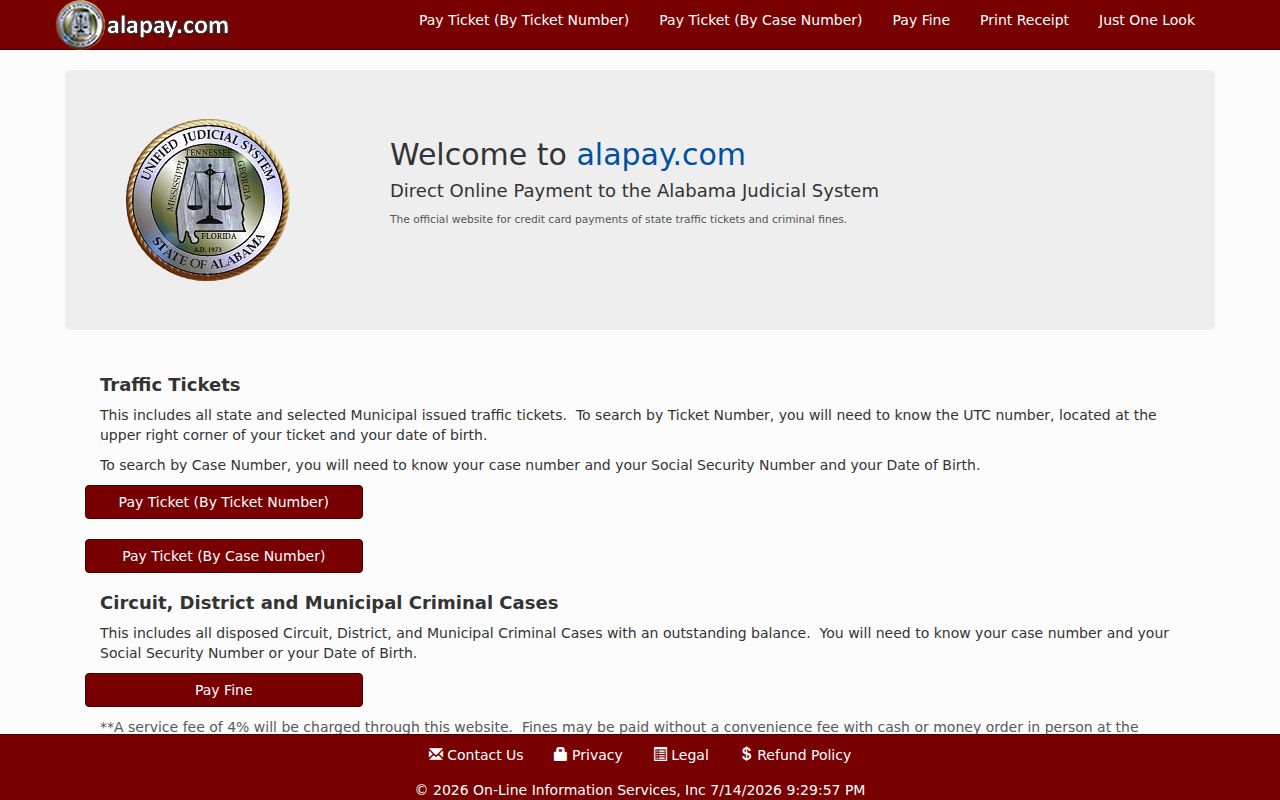
The payment screen should be read as one task within a case, while the clerk's file remains the source for status and disposition.
Keep the payment confirmation and check the case action summary afterward. Municipal portals have their own limited purpose, and an item on an Evergreen or Castleberry payment page may not be a Conecuh Circuit or District case. The issuing court controls the obligation.
Case Record Access & Restrictions
Alabama's public-record rules support access to public writings, but separate laws protect restricted records and information. Juvenile and Youthful Offender cases, qualifying expunged matters, protected victim details, personal identifiers, and some sealed or active-investigation material may be withheld or redacted. The public electronic view can be narrower than the releasable clerk file, and even the clerk cannot disclose material barred by law.
Ask for the exact case and document, such as the complaint, case action summary, judgment, sentencing order, or certified disposition. If an electronic result is absent, contact Room 203. If access is denied or a copy is redacted, ask the custodian which rule controls and whether a releasable version exists. The Alabama Open Records Act inspection provision supplies the general public-writing rule, while the expungement chapter and confidentiality laws narrow access for qualifying records.
The court file answers what was filed and how it ended. It should not be replaced by the booking charge, a payment portal, an app alert, or a statewide criminal-history summary.